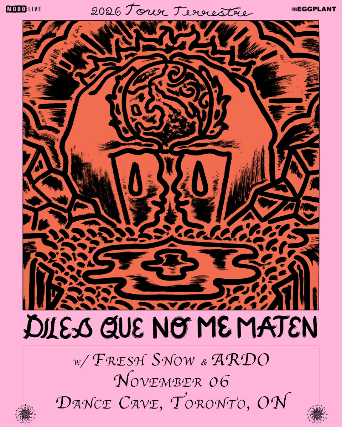
MODO-LIVE Presents
Diles Que No Me Maten with Fresh Snow & ARDO
Fri, 6 November
Doors open
8:00 PM EST
The Dance Cave
529 Bloor Street West, Toronto, ON M5S 1Y5
Description
MODO-LIVE Presents
Diles Que No Me Maten
w/ Fresh Snow & ARDO
Friday, November 6th 2026
Dance Cave
Toronto, ON
Event Information
Age Limit
19+
Capacity
270
Refund Policy
ALL SALES FINAL.
NO REFUNDS/NO EXCHANGES
Alternative
Diles Que No Me Maten
Diles Que No Me Maten
Alternative
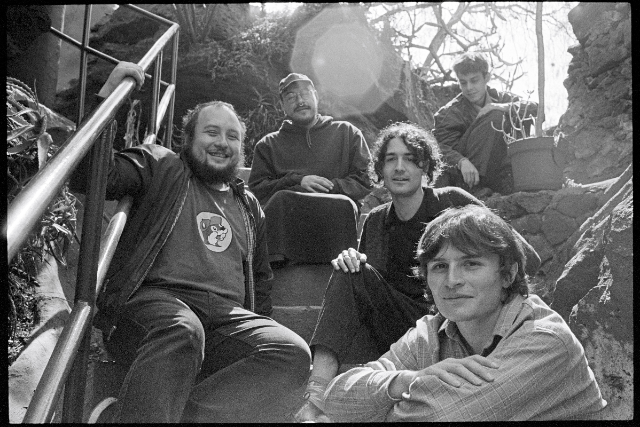
For Diles que no me maten, every note is a small step into the unknown. The five-piece Mexico City band have always operated on a first-thought, best-thought basis, drawing on a jam-based, krautrock philosophy to craft intricate constructions of wiry art rock spiked with bluesy balladry and poetic mysticism. While their fourth album Escrito en Agua (Writ in Water) is their most consciously crafted and accessible to date, their founding principle of slow, wide-eyed exploration is alive and well.
Founded by brothers Raúl (drums) and Gerardo (guitar) Ponce in 2017 in a CDMX scene set to bubble over, Diles bonded over a shared improvisational language that grew more complex and fluid with each revelatory rehearsal and electric live performance. The fiery mix of raw elements that fueled their 2020 debut EP Cayó de su Gloria el Diablo and LP Edificio coalesced into solid-built but shapeshifting entities on their breakout album La Vida de Alguien Más and its free-flowing follow-up Obrigaggi. Together with the Ponces, Andrés Lupone (bass), Jerónimo Elizondo-García (guitar, clarinet), and Jonás Derbez (vocals, saxophone) have crafted a sound that’s as unpredictable as it is distinct.
In a makeshift studio space in their hometown’s Santa María La Ribera neighborhood, Diles created Escrito en Agua through a process of intense experimentation and refinement, guided gently by their longtime collaborator turned producer Sebastián Rojas. This setting gave these recordings a scrappy mutability; unencumbered by the hi-fi confines of an official studio, they were free to tinker with their unruly creations, breaking them down and reassembling their best parts in a way they’d never done before.
It’s evident from the opening notes of Escrito en Agua that Diles have entered a new chapter. Instrumental intro “Las Noches Que Dormimos en Sillas” (“The Nights We Sleep on Chairs”) was first conceived as a “Goth Duke Ellington arrangement” by Andrés before some technical malfunctions and a guest performance from legendary saxophonist Alain Derbez (Jonás’s father) led the band to realize the song would sound better an octave higher. Thus, its lugubrious tones became less moody and more spiritual. They leaned in, injecting elements of funerary music from Oaxaca’s Sierra Mixe that elevate the song far beyond its playful original premise. The track sets the tone for an album that, while possessing no airs of religiosity, is as transcendent as gospel.
This aura is put into words on lead single “Hiriku,” which finds Jonás interpreting José Vincente Anaya’s epic poetic vision quest Híkuri (Peyote) over frenetic krautrock instrumentation. “La mitad que soy no existe, y la mitad que existe no soy,” he repeats with mantra-esque calm in the song’s second half (“The half I am doesn’t exist, and I am not the half that exists”). This egocidal phrase, ripped directly from the poem, is a gauntlet of sorts; leave your previous self behind as you enter this record. “Cierro los ojos para ver un lugar donde no estoy,” he sings elsewhere (“I close my eyes to see a place where I am not”).
Sonically, the high-octane “Hiriku” is an exception on a record full of unhurried reflection. Escrito en Agua’s languid tone is due in large part to Raúl’s decision to pare down his drumming to its most minimal form. “I wanted to make all the drums on the album really tame,” he says. “I really like that feeling of having less things so you can concentrate on all the other things that are happening at the same time.” Gerardo took a similar tack in his approach to guitar on the album. “Silence is a big element of the record,” he says, “the spaces that you take in silence and the silence you make after you play.”
If “Hiriku” is Escrito en Agua’s thematic looking glass, “Perquisidor” is its encryption key. Translating roughly to “Investigator,” the song’s title character is more of an observant wanderer than a traditional detective. “It’s wandering not in the sense of being lost, just in the sense of seeking something,” Jonás clarifies. “But you're not specifically seeking something that is a goal. You're only seeking details. I think of it as wandering with a clear vision of something that you cannot discover. You're on the trail of something that you know you're not gonna figure out, but you're still paying attention to these clues.”
When composing the song’s arrangement, Andrés put himself in that role. “I wasn't sure what I was going for,” he says. “Sometimes the chords are happy and sometimes the chords are sad, but I wouldn't call it either a happy song or a sad song. It's like an epic of nothing.”
This ambiguity, which carries throughout Escrito en Agua, is perhaps best exemplified on “Viene el Viento,” a song about aging and death that’s heartbreakingly tender but never overtly depressive. It was the first song Diles recorded for the album, and they approached it like a puzzle, aiming to present distinct moods musically and lyrically. There’s no misdirection here, though; in fact, it’s one of the project’s most jarringly vulnerable cuts. Channeling the great Argentinian songwriter Luis Alberto Spinetta (Pescado Rabioso), Jonás strove for equal parts emotional depth and childish simplicity. “It's really naked,” he says.
The album’s emotional tipping point, though, comes on its penultimate track, “No me.” Growing out of an instantly classic guitar riff from Jerónimo and the only lyrics on the project that Jonás had written before the sessions began, it’s rooted in an assertion of strength and self-dependence: “No me está rompiendo. Creo que no me va a romper.” (“It’s not breaking me. I believe that it won’t break me.”) As Jonás says it over and over, his confidence seems to waver, then fail, then rise again. “It was about repeating ‘This is not going to break me’ in a way that it sounds like it has completely broken me down,” he explains.
“No me” isn’t a hard song to play technically, but it was the trickiest for Diles que no me maten to nail down. Re-recorded several times across three locations, it’s now perhaps the track they’re proudest of in their discography. “It's a song where we listen to each other a lot while playing, and when we're on tour and we're playing every day and we have different feelings or a common feeling, we play that song, and it's like, ‘OK, we understand,’” Jonás says. “That's why it's so important.”
Escrito en Agua has two dedicatees. The first is the morning star Tunuwame, the patron of singers and musicians according to western Mexican indigenous myth. “Estrella tan distante, si te dejo de cantar
me desperdiciare,” Jonás sings on the album’s closing track, named for the celestial orb (“Star so distant, if I stop singing to you, I’ll waste myself”). The second is Mahmoud Darwish, widely regarded as Palestine’s national poet, whose “documentary poems” Jonás looked to for inspiration for various songs on the recording a way he’d never done with another writer’s work. “He's just writing the day-to-day of living in a sieged state, just writing about the small visions he sees,” he reflects, remembering what first appealed to him so much about Darwish. It’s these smaller visions that make Escrito en Agua the masterpiece it is. Unassuming in its brilliance, it flows one note at a time into a great unknown of endless possibility.